


Choosing a TTR slitting machine is not only a question of machine price. For thermal transfer ribbon converters, the right choice depends on production volume, roll quality expectations, operator skill, material range, and future growth plans. An entry-level machine can be practical for starting production or handling smaller orders, while a high-speed TTR slitting machine may be more suitable for factories that require higher efficiency, stable output, and more automated operation.
This article compares entry-level and high-speed TTR slitter rewinder solutions from a practical purchasing perspective, helping barcode ribbon producers and converting plants evaluate which machine structure better matches their current and future production requirements.
What Is a TTR Slitting Machine?
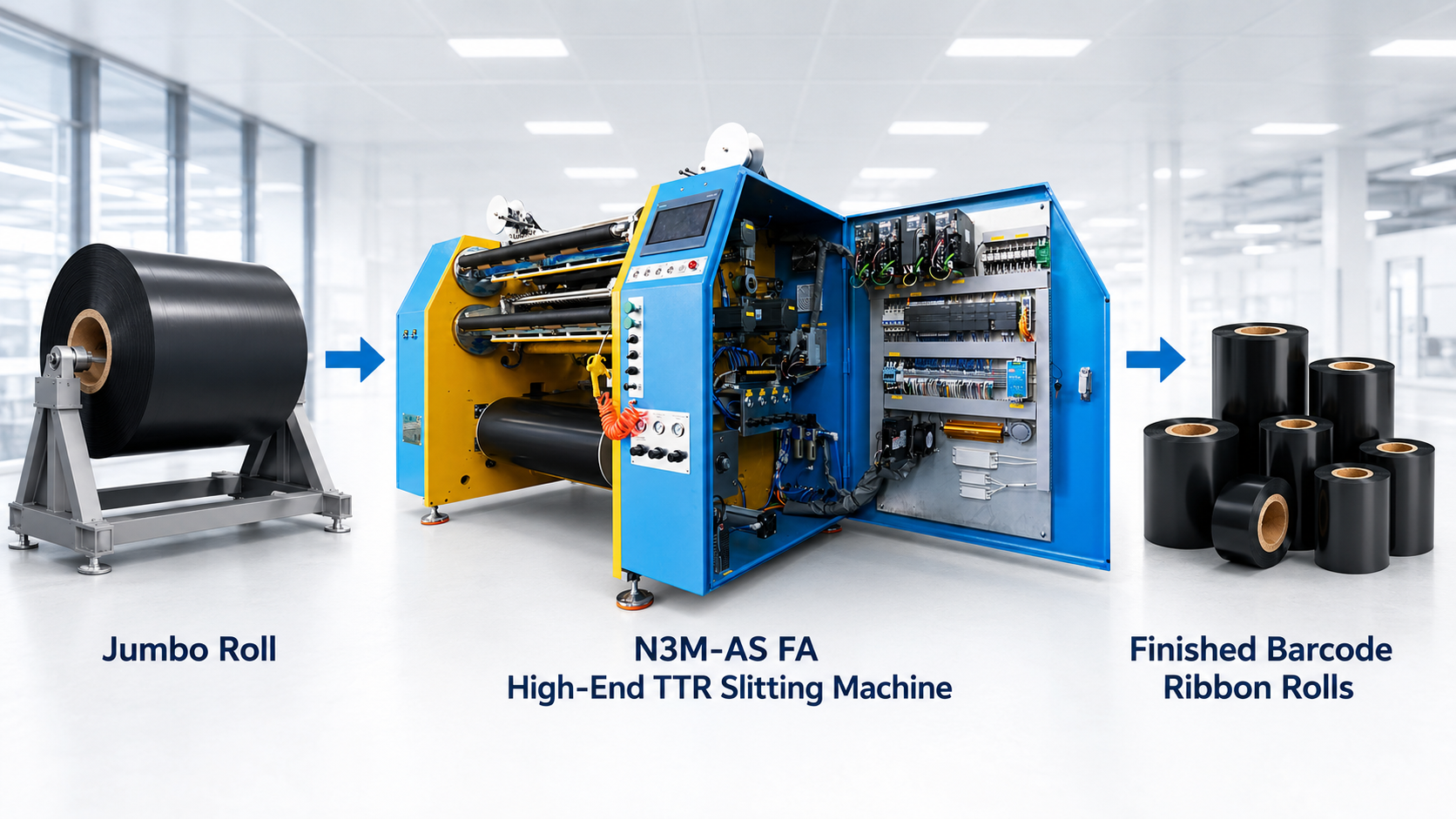
A TTR slitting machine is used to slit jumbo rolls of thermal transfer ribbon into narrower finished rolls for barcode printing, label printing, packaging coding, logistics labels, and industrial identification applications. TTR materials usually include wax, wax-resin, and resin ribbon structures, and different ribbon grades may require different tension, rewinding, and edge control conditions.
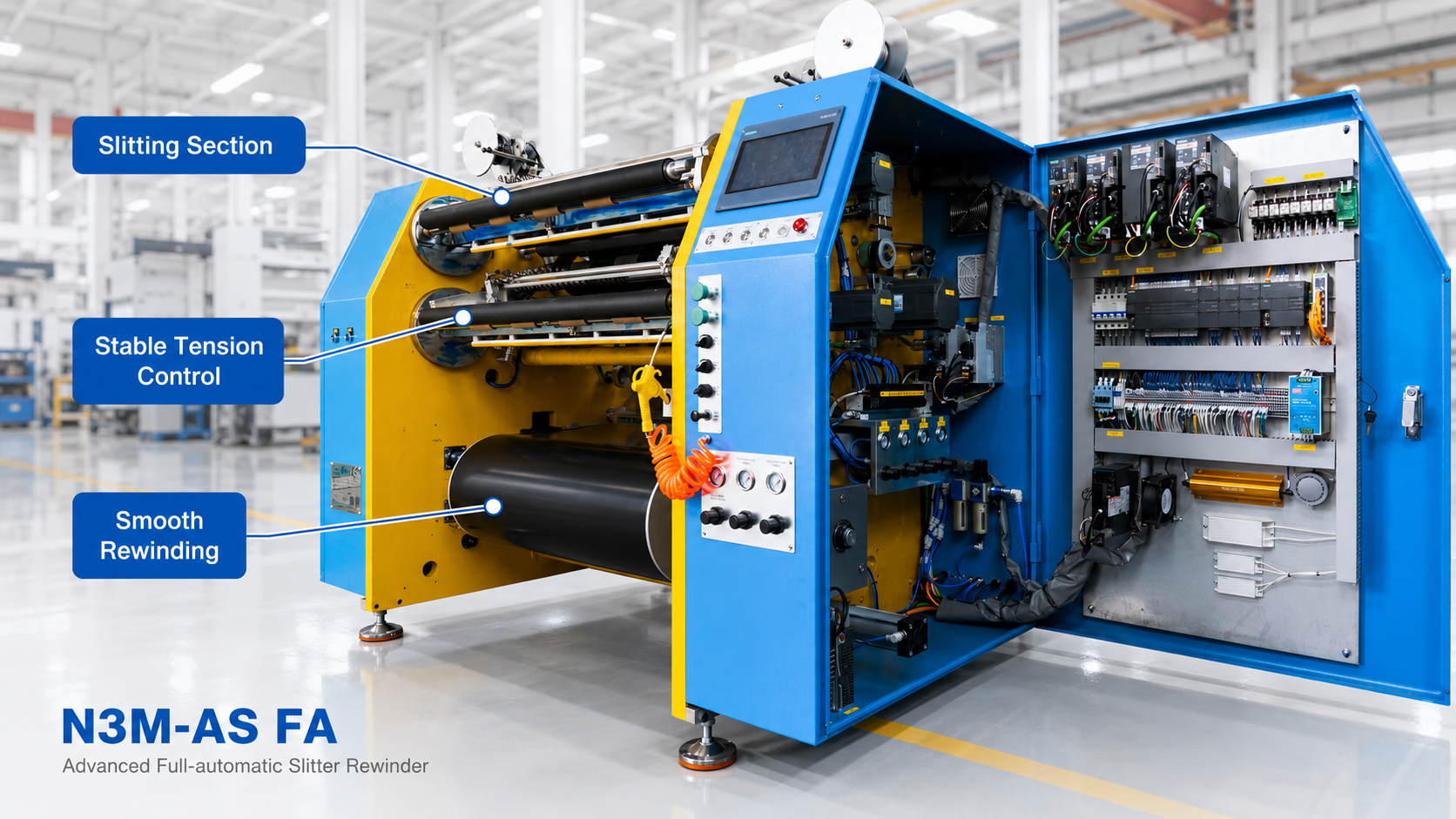
The machine process normally includes unwinding, web guiding, slitting, rewinding, finished roll handling, and inspection. For TTR converting, stable tension control and smooth rewinding are especially important because ribbon rolls must run reliably in printers without wrinkles, telescoping, or uneven roll hardness.
Entry-Level TTR Slitting Machine: When Is It Suitable?
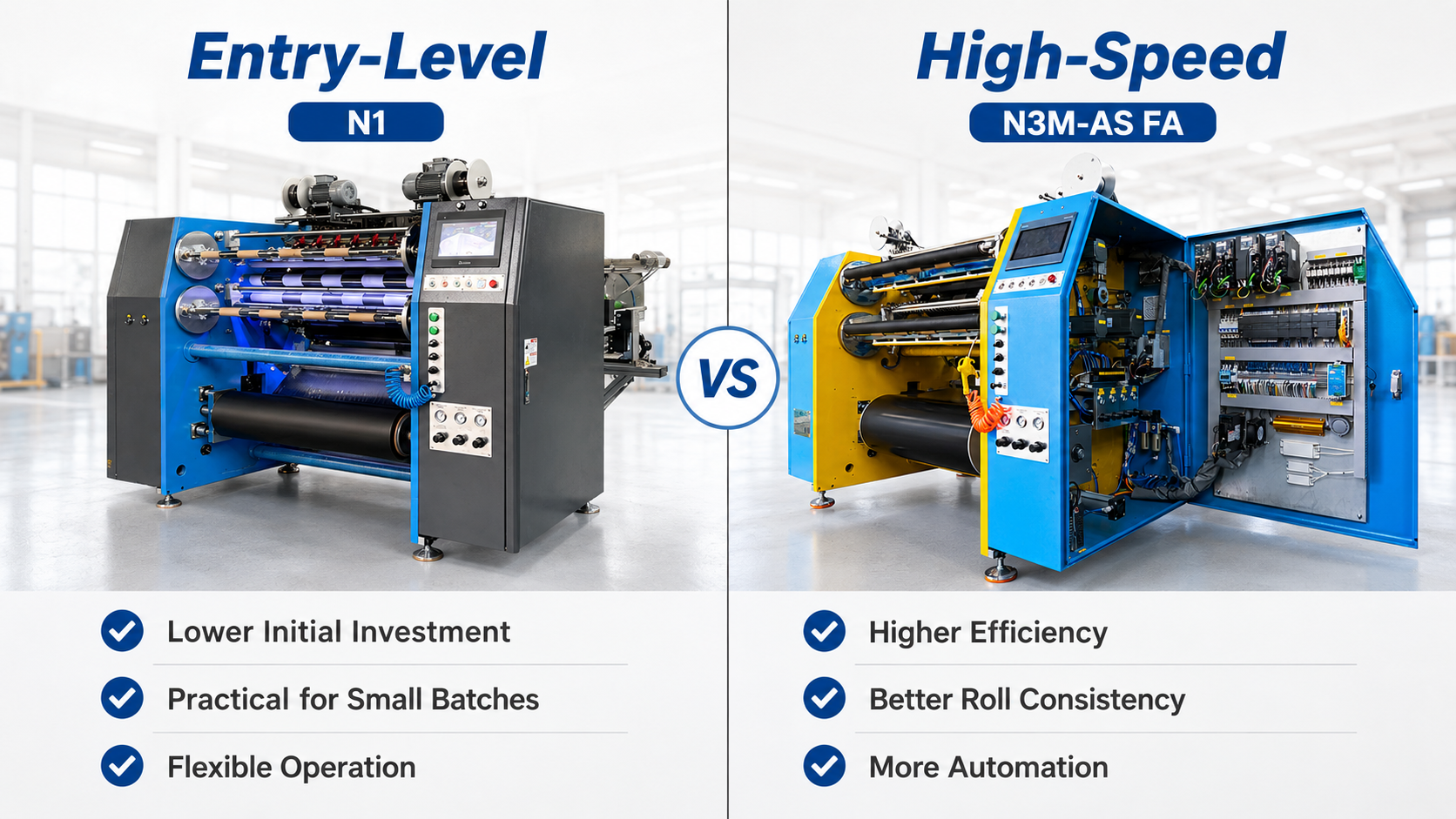
An entry-level TTR slitting machine is usually selected by new converters, small ribbon workshops, or factories with moderate order volume. It is often chosen when the buyer wants to control initial investment, build production experience, or serve local customers with flexible order quantities.
This type of solution can be suitable when production is not yet continuous, finished roll specifications change frequently, or the factory needs a practical machine for daily ribbon slitting without a high level of automation. It may also be useful for converters that want to test a new market before investing in a more advanced automatic TTR slitter rewinder.
However, buyers should not evaluate entry-level equipment only by purchase cost. They should also consider roll consistency, machine stability, operator workload, waste control, and long-term maintenance. A lower initial investment may not always mean lower total cost if the machine creates frequent downtime or unstable finished rolls.
High-Speed TTR Slitting Machine: When Does It Make Sense?
A high-speed TTR slitting machine is generally more suitable for factories with stable orders, higher daily output targets, and stricter requirements for finished roll quality. When the same factory needs to process large quantities of barcode ribbon with consistent specifications, a more automated and efficient slitter rewinder can help improve production organization.
High-speed TTR slitting is not simply about running faster. The real value comes from stable unwinding, precise slitting, controlled rewinding tension, efficient roll changeover, and reduced operator dependence. For ribbon producers supplying distributors, label printing customers, or OEM packaging users, consistent finished roll quality often matters as much as output capacity.
Factories should consider a high-speed solution when production bottlenecks appear, manual handling becomes inefficient, or customers demand more consistent roll appearance and delivery schedules. For growing converters, automation can also support better production planning and more repeatable operation.
Entry-Level vs High-Speed TTR Slitting Machine Comparison
|
Selection Point |
Entry-Level TTR Slitting Machine |
High-Speed TTR Slitting Machine |
|
Typical buyer |
New converters, small workshops, flexible order producers |
Established ribbon converters with stable or growing volume |
|
Main advantage |
Lower initial investment and simpler operation |
Higher efficiency, better consistency, and stronger automation potential |
|
Operator workload |
More manual adjustment and handling may be required |
More automated functions can reduce repetitive operation |
|
Roll quality focus |
Suitable for standard roll requirements when properly configured |
Designed for more consistent roll appearance and production repeatability |
|
Future expansion |
Good for starting or testing the market |
Better for scaling production and serving larger order demand |
Key Factors to Consider Before Choosing
Before choosing between entry-level and high-speed equipment, buyers should review their real production conditions instead of selecting only by machine name or budget. The following points are especially important:
Material type: wax, wax-resin, resin ribbon, or other coated ribbon structures.
Mother roll size: width, diameter, core size, and roll weight according to actual supply conditions.
Finished roll requirements: roll width, length, core type, winding direction, and packaging method.
Production target: daily output, shift arrangement, order stability, and changeover frequency.
Quality expectations: edge quality, roll hardness, wrinkle control, end-face appearance, and printer compatibility.
Operator skill level: available technicians, training time, and preference for manual or automatic functions.
Future plan: whether the factory wants to start small or build capacity for long-term growth.
Recommended HAVESINO Solution for TTR Slitting
HAVESINO Group provides TTR slitting machine solutions for different production stages, from practical entry-level configurations to more automated TTR slitter rewinder options. The suitable model and configuration should be selected according to material type, mother roll size, finished roll requirements, production target, and automation expectations.
For buyers who are starting TTR converting or handling moderate production volume, an N2M TTR slitter can be considered when a practical ribbon slitting solution is needed. For factories that require higher automation and more efficient production organization, models such as the fully automatic TTR slitter rewinder N3M-AS can be evaluated according to actual production needs.
HAVESINO focuses on stable tension control, clean slitting, smooth rewinding, and reliable machine structure. With 16+ years in slitting and rewinding equipment, serving customers in 100+ countries and regions with 2,000+ installed machines, HAVESINO can help buyers discuss a suitable TTR slitting solution based on real production information.
Common Mistakes When Choosing a TTR Slitter Rewinder
One common mistake is choosing a machine only by maximum speed. If the material tension, slitting quality, rewinding structure, and operator workflow are not suitable, a higher speed setting may not deliver better production results. Another mistake is underestimating future capacity. A factory that expects fast order growth should consider whether the selected machine can support future business development.
It is also important not to ignore technical communication before purchase. Buyers should prepare detailed information about ribbon material, roll sizes, slitting widths, finished roll standards, and target output. The more complete the information, the easier it is for the manufacturer to recommend a practical configuration.
FAQ
Is an entry-level TTR slitting machine enough for a new business?
It can be enough for a new converter when the order volume is moderate and the factory wants to control initial investment. The final choice should still consider roll quality requirements, operator experience, and future capacity plans.
Is a high-speed TTR slitting machine always better?
Not always. A high-speed machine is valuable when the factory has enough order volume, stable specifications, and the need for higher efficiency. If production is small or highly variable, a practical entry-level solution may be more suitable.
What information should I provide before asking for a machine recommendation?
You should provide ribbon material type, mother roll width and diameter, finished roll width and length, core size, winding direction, daily output target, and any special packaging or inspection requirements.
Can one TTR slitter process wax, wax-resin, and resin ribbon?
In many cases, one machine can be configured for different ribbon types, but the final suitability depends on material structure, coating condition, tension range, and finished roll requirements.
How does tension control affect TTR finished roll quality?
Stable tension control helps reduce wrinkles, loose winding, telescoping, and uneven roll hardness. This is important because TTR rolls must run smoothly in barcode and label printers.
Conclusion: Choose Based on Real Production Needs
The best TTR slitting machine is the one that matches your current production requirements while leaving reasonable space for future growth. Entry-level equipment can be a practical starting point, while a high-speed TTR slitting machine is more suitable for factories that need higher efficiency, stronger consistency, and improved production organization.
Share your ribbon material type, mother roll size, finished roll requirements, and production target with HAVESINO to discuss a suitable TTR slitter rewinder configuration.